
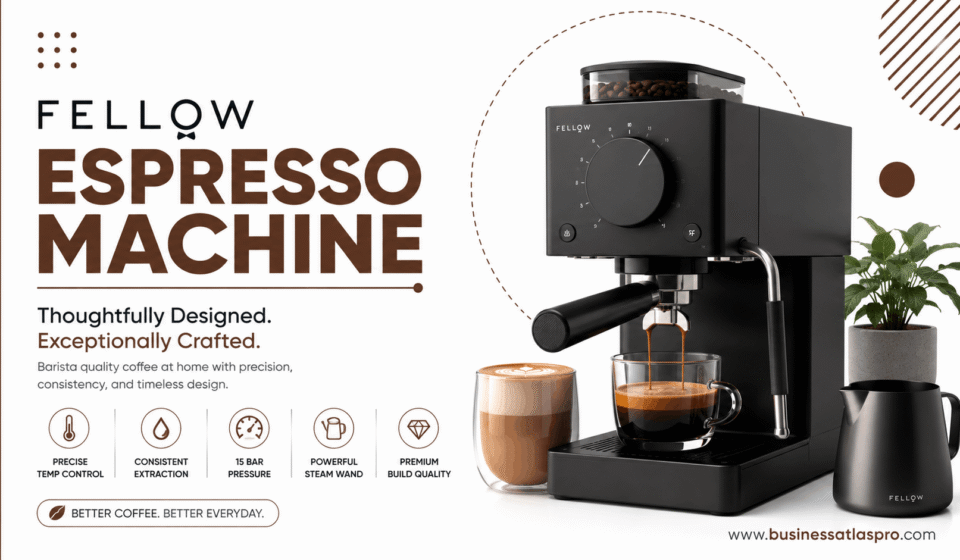

The Fellow espresso machine landed in a crowded market and somehow managed to make a lot of experienced home baristas stop and pay attention. That doesn’t happen often. Fellow built a reputation on beautifully designed kettles and grinders first. So when they announced an espresso machine, people were curious—and a little skeptical. Let me tell you what the fuss is actually about.
What the Fellow Espresso Machine Actually Is
Fellow released the Opus — their grinder — to serious acclaim before moving into espresso machines. Their espresso offering, the Fellow Opus One, reflects the same design philosophy: clean lines, thoughtful features, and a focus on removing friction from the brewing process.
It’s a prosumer-leaning home espresso machine. That puts it above beginner machines in both price and capability, but below the commercial-grade equipment you’d find in a specialty café.
The machine is built around pressure profiling — a feature that used to be reserved for machines costing three to five times more. This lets you control how pressure builds during extraction. And that matters because espresso is extraordinarily sensitive to pressure changes throughout the shot.
At its core, it’s designed for people who care about coffee quality but don’t want to spend hours troubleshooting. It sits in that sweet spot between accessible and serious.
What Pressure Profiling Actually Does
When you pull a shot of espresso, the water pressure applied to the puck of ground coffee affects flavor dramatically. A flat 9 bars of pressure from start to finish is the traditional standard. But variable pressure — ramping up slowly, then tapering — can bring out sweetness and reduce bitterness.
The Specialty Coffee Association has published research on how extraction variables affect cup quality. Pressure is one of the most impactful variables in that equation.
The Fellow espresso machine lets you program these pressure curves. You’re not stuck with a one-size-fits-all extraction. That’s a meaningful capability for anyone dialing in a specific coffee.
How the Fellow Espresso Machine Handles Temperature
Temperature stability is one of the most overlooked factors in home espresso. Even a 2°C swing during extraction changes the flavor profile noticeably.
Cheaper machines heat up once and then fluctuate. The Fellow espresso machine uses PID temperature control—a system that continuously monitors and adjusts boiler temperature to hold it precisely at your target.
You can set your brew temperature and trust it. That consistency is what makes it possible to actually learn from your shots. If the temperature is jumping around, you can’t isolate what else is affecting the cup.
It also has a separate steam boiler. That matters. Single-boiler machines make you wait between pulling a shot and steaming milk — the boiler needs to reheat to a higher temperature for steam. Dual-boiler or heat exchanger systems handle both simultaneously.
The Fellow espresso machine uses a heat exchanger design. You can pull a shot and steam milk without a significant wait. For anyone making lattes or cappuccinos daily, this is a practical quality-of-life feature.
The Design: Why It Stands Out on a Counter
Fellow has always prioritized aesthetics. Their Stagg kettle became popular partly because of how good it looks sitting on a counter. The same attention carries into the Fellow espresso machine.
It’s compact relative to its feature set. The exterior is clean, with minimal visual clutter. Controls are straightforward without feeling dumbed down. It doesn’t look like a machine you have to apologize for when guests see your kitchen.
But design isn’t purely cosmetic here. The drip tray is well-sized and easy to remove. The portafilter—the handle you load coffee into—has a solid, substantial feel. The water reservoir is accessible and easy to fill.
In my experience, these small ergonomic details determine whether a machine gets used every day or pushed to a corner. A machine that’s annoying to clean or awkward to operate gets ignored. The Fellow espresso machine doesn’t have those friction points.
Grind Quality Matters as Much as the Machine
Let’s be direct about something. The best espresso machine on the planet can’t save bad grind quality. Espresso requires an even, fine grind with minimal fines—tiny dust particles that clog the puck and cause uneven extraction.
If you’re buying a Fellow espresso machine and pairing it with a cheap blade grinder, you’re leaving most of the machine’s potential untapped. A quality burr grinder is not optional at this level.
Fellow makes the Opus grinder and the Ode, both of which pair well with their espresso machine. But other reputable options like the Baratza Sette or Eureka Mignon series also work well.
Budget at least $150–$300 for a grinder alongside your machine. The combination of a decent grinder and the Fellow espresso machine will outperform a mediocre grinder paired with a machine twice the price.
Who the Fellow Espresso Machine Is Actually For
This is where I want to be honest with you. The Fellow espresso machine isn’t for everyone. And that’s not a knock—it’s just reality.
It’s a great fit if:
You’ve already been making espresso for a while and feel limited by your current machine. You understand what extraction means. You want to experiment with variables like temperature and pressure rather than just pressing a button and hoping for the best.
You also drink espresso regularly. A machine at this price point needs to be used consistently to justify the investment. If you pull one shot a week, this is overkill.
It might not be for you if:
You’re brand new to espresso and still learning the basics. A more beginner-friendly machine like the Breville Bambino Plus would serve you better to start. It’s forgiving, fast, and lets you learn fundamentals without wasting expensive coffee while you figure things out.
Or if you want full automation. The Fellow espresso machine is semi-automatic. You control the grind, dose, tamp, and shot timing. If you want a machine that does all of that for you, look at super-automatic machines instead.
The Setup and Learning Curve
Getting a Fellow espresso machine dialed in takes time. That’s not a design flaw — it’s the nature of semi-automatic espresso. Expect your first week to involve some sour shots (under-extracted) and some bitter ones (over-extracted) while you find the right grind size and dose for your beans.
The machine’s consistency actually helps with this learning process. Because temperature and pressure are stable, you can isolate the variables you’re adjusting. Change the grind size one click, pull another shot, and compare. That iterative process is how you learn.
Barista Hustle is an excellent free resource for understanding espresso variables. Their guides on extraction and dialing in are thorough and practical for home baristas.
Once you’re dialed in for a specific coffee, the shots are genuinely excellent. The pressure profiling capability lets you get results that feel café-quality at home. And that’s when the investment starts making sense.
Maintenance: What You Need to Stay on Top Of
Espresso machines need regular cleaning. Oils from coffee build up inside the group head—the part where water meets the coffee puck. Left uncleaned, they go rancid and affect flavor.
For the Fellow espresso machine, backflushing with a cleaning tablet weekly is the standard routine. It pushes soapy water back through the group head and flushes out coffee residue. Most modern machines make this process straightforward.
Descaling is the other major maintenance task. Mineral buildup from water accumulates inside the boiler and pipes over time. How often you need to descale depends on your water hardness. Soft water means less frequent descaling. Hard water — like in many city tap systems — means more.
Using filtered water extends the time between descales and protects internal components. It also genuinely improves espresso flavor. Dissolved minerals in water affect extraction chemistry in measurable ways.
Keep a cleaning schedule. Machines that get neglected start producing off-tasting shots without any obvious explanation. Regular cleaning is the cheapest maintenance you can do.
Comparing the Fellow Espresso Machine to Competitors
At its price point, a few machines compete directly. The Rancilio Silvia Pro X offers rock-solid build quality and a devoted community but a more industrial look. The ECM Classika is beloved for longevity. The Lelit Mara X handles heat exchange beautifully.
What sets the Fellow espresso machine apart is the combination of software-driven temperature control, pressure profiling accessibility, and modern design. The competitors often win on raw build quality — more metal, more heft. But they require more manual work and expertise to get the most out of them.
If you prioritize a modern interface and programmable features, Fellow edges ahead. If you want a machine built like a tank that you’ll pass down to someone in twenty years, the Italian machines have an edge.
There’s no objectively right answer. It depends on what you value in the experience of making espresso at home.
The Bottom Line on the Fellow Espresso Machine
What Fellow has built is a machine that makes serious espresso accessible without making it effortless. There’s still a learning curve. There’s still work involved. But the tools are there to do it properly.
I’ve noticed that home baristas who invest in understanding what their machine can do—rather than just turning it on and hoping—get dramatically better results within a few weeks. The Fellow espresso machine rewards that curiosity.
If you’re ready to put in the time and already have a quality grinder—or plan to buy one—this machine will deliver. It’s not an impulse purchase. But for the right person, it’s one they won’t regret.