
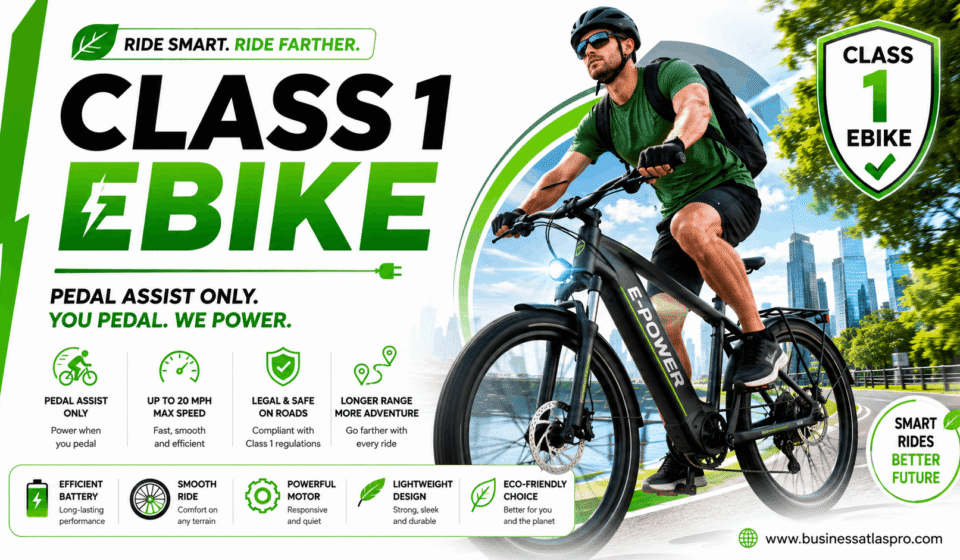

If you’ve been curious about electric bikes but don’t want to deal with complicated laws or registration paperwork, a class 1 ebike is probably exactly what you’re looking for. It’s the most straightforward category in the ebike world. And it’s the one that fits into everyday life with the least friction.
Let me walk you through what makes it tick, where you can ride it, and whether it’s the right fit for you.
What Exactly Is a Class 1 Ebike?
A class 1 ebike is a pedal-assist electric bicycle. That means the motor only kicks in when you’re actively pedaling. The moment you stop pedaling, the motor cuts out. Simple as that.
The motor assistance tops out at 20 mph. Once you hit that speed, you’re on your own—the electric assist stops. You can keep going faster under your own power, but the motor won’t push you beyond that threshold.
There’s no throttle on a class 1 ebike. That’s a key distinction from Class 2 bikes, which let you twist a throttle and move without pedaling at all. Class 1 is purely pedal-activated.
This matters more than you might think. The pedal-assist design makes the riding feel more natural. It’s not like sitting on a moped. It feels like cycling—just with a really impressive tailwind following you everywhere.
The Consumer Product Safety Commission classifies these bikes as bicycles under federal law, which is a big part of why they’re so accessible.
Why the Class 1 Ebike Has the Most Riding Access
This is where the class 1 ebike really earns its reputation. Because it’s pedal-assist only and capped at 20 mph, it’s allowed in more places than any other ebike category.
Most bike paths, multi-use trails, and bike lanes that permit regular bicycles also permit class 1 ebikes. That includes a huge number of national parks, state trails, and urban cycling infrastructure.
Class 2 and Class 3 bikes face more restrictions. Many trails ban dirt bikes outright. And Class 3 bikes — which assist up to 28 mph — are often restricted from bike paths entirely.
So if you want to ride on the rail-trail network or local greenways without worrying about getting kicked off, a Class 1 e-bike is your safest bet. It opens doors rather than closing them.
State Laws and What to Know
Laws do vary by state. Most US states have adopted the three-class ebike framework, but not all. A handful of states still have their own definitions.
Before you ride anywhere specific, check your local regulations. The People for Bikes resource is a solid place to verify state-by-state ebike laws. It’s updated regularly and covers trail access rules too.
Generally speaking, class 1 ebikes don’t require registration, a license, or insurance in most states. That’s a meaningful advantage if you’re replacing car trips with bike trips.
How the Motor and Pedal Assist Actually Work
The motor on a class 1 ebike responds to your pedaling through a sensor system. There are two main types: cadence sensors and torque sensors.
Cadence sensors detect whether you’re pedaling at all. The moment the cranks turn, the motor engages at whatever assist level you’ve selected. It’s a binary on/off feel—you pedal, and the motor helps. You stop; it doesn’t.
Torque sensors are more sophisticated. They measure how hard you’re pushing on the pedals and match the motor output proportionally. Pedal harder and get more help. Coast lightly and get less.
Torque sensor systems feel much more natural. They respond like a real bike that just happens to be very light on hills. In my experience, this is the single biggest factor that separates a great ebike ride from a clunky one.
Mid-drive motors—where the motor sits at the crank—typically pair with torque sensors and deliver the best overall feel. Hub motors are common on budget bikes and work fine, but they don’t replicate the natural ride feel as well.
Who Should Buy a Class 1 Ebike
Not everyone needs the same thing from an electric bike. So let’s be honest about who this category serves best.
Commuters and Daily Riders
If you’re using a bike to get to work, run errands, or replace short car trips, a class 1 ebike is ideal. You arrive without drenching your work clothes in sweat. You still get exercise. And you’re not dealing with parking or fuel costs.
The assist kicks in exactly when you need it—climbing that annoying hill near your office or pushing through headwinds on the way home. And since you’re still pedaling, you’re actually building fitness over time.
Trail Riders and Weekend Cyclists
Mountain bikers and recreational trail riders love class 1 ebikes for the access they provide. You can cover more ground, tackle longer climbs, and spend more time exploring rather than grinding.
And because class 1 bikes are allowed on most natural surface trails where other ebike classes aren’t, you’re not limited in where you can go.
Older Riders and Those Returning to Cycling
This is a use case that doesn’t get talked about enough. A class 1 ebike lets people with joint issues, reduced fitness, or health conditions get back on a bike without the physical barriers.
You still move your legs. You still get cardiovascular benefits. But the assist absorbs the parts of riding that might otherwise be too demanding. That’s genuinely valuable.
Class 1 vs. Class 2 vs. Class 3: The Quick Comparison
It helps to see all three side by side.
| Feature | Class 1 | Class 2 | Class 3 |
|---|---|---|---|
| Max assist speed | 20 mph | 20 mph | 28 mph |
| Throttle | No | Yes | Optional |
| Pedal-assist | Yes | Yes | Yes |
| Trail access | Broadest | Restricted | Most restricted |
| License needed | Usually not. | Usually not. | Some states, yes. |
So if you want speed, Class 3 delivers it. If you want throttle convenience, Class 2 has it. But if you want access, simplicity, and a natural ride feel, the class 1 ebike wins cleanly.
What to Look for When Buying a Class 1 Ebike
There’s a lot of noise in the ebike market right now. Here’s what actually matters.
Motor and Battery
For most riders, a 250W–500W motor is plenty. You don’t need 750W unless you’re hauling cargo up steep hills regularly. Battery capacity is measured in watt-hours (Wh). A 400–500 The Wh battery gets most people 30–50 miles of real-world range on a single charge.
Range claims on manufacturer websites are almost always optimistic. They’re usually measured on flat terrain with minimal assist. Real-world range with hills and heavier assist will be lower. Plan accordingly.
Frame and Fit
Don’t overlook this. A bike that doesn’t fit you well is uncomfortable regardless of how good the motor is. Step-through frames work well for riders who want easy mounting and dismounting. Traditional diamond frames feel more sporty.
Test ride if you can. Many local bike shops now stock quality class 1 ebikes from brands like Trek and Specialized. Getting on the bike before buying tells you more than any spec sheet.
Build Quality
Stick to brands with real warranty support and available replacement parts. Cheap off-brand ebikes flood the market. Some are fine. Many are not. A reputable brand costs more upfront but saves you headaches later.
Wirecutter’s ebike reviews are a good starting point for narrowing down which models consistently hold up.
Maintenance: What’s Different About an Ebike
Mechanically, a class 1 ebike is mostly a regular bike. Tires, brakes, chain, and cables—all standard bike maintenance. The electric components add some specific things to think about.
Battery care is the big one. Don’t store a lithium battery fully depleted or fully charged for long periods. Keeping it between a 20% and 80% charge extends its lifespan significantly.
Brake pads wear faster on ebikes. The added speed and weight mean you’re stopping more mass more often. Check them regularly.
Software updates — some brands push firmware updates through a companion app. These can improve motor performance or fix bugs. Worth keeping up with.
And always keep your motor connection points clean and dry, especially if you ride in wet conditions. Moisture intrusion into electrical connections is the most common source of ebike electrical failures.
The Real Reason People Love a Class 1 Ebike
It’s not the technology. It’s what the technology lets you do.
You ride more. You ride farther. You ride on days when you might have skipped it. I’ve noticed that people who switch to a class 1 ebike for commuting end up riding more total miles per week than they did on a regular bike. The assist removes the mental barriers. The “I’m too tired” excuse disappears.
That’s the real value here — not horsepower, not top speed, but consistency. A class 1 ebike makes cycling something you actually do rather than something you plan to do someday.
If you’ve been on the fence, the access advantages and natural ride feel make it the easiest category to recommend to almost anyone.
Also Read: IPHUB: What It Is and Why It Matters for IP Detection