
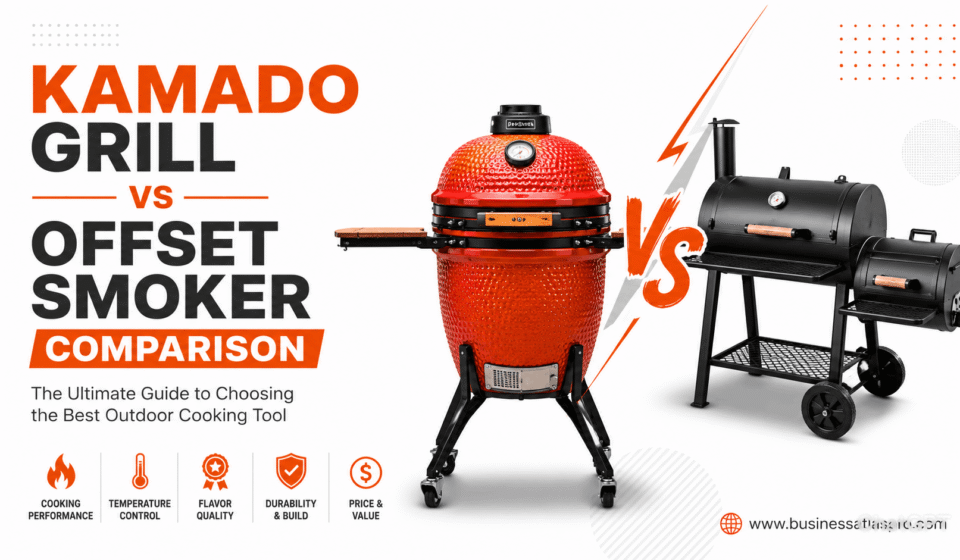

If you’ve been trying to decide between these two cookers, you’re not alone. The kamado grill vs offset smoker comparison is one of the most common debates in the backyard BBQ world — and for good reason. Both produce incredible food. But they work differently, suit different cooking styles, and come with very different learning curves. Let me walk you through what actually matters when choosing between them.
What Each Cooker Actually Is
Before the comparison gets practical, it helps to understand what you’re dealing with.
A kamado grill is a thick-walled, egg-shaped cooker made from ceramic or similar refractory material. The design traces back thousands of years to ancient clay cooking vessels used in Asia. Modern versions — like the Big Green Egg and Kamado Joe — have refined that concept into a remarkably versatile backyard cooker.
The ceramic walls retain heat exceptionally well. You can sear steaks at 700°F or smoke a brisket low and slow at 225°F. The tight-fitting dome lid creates a controlled cooking environment. Adjustable top and bottom vents regulate airflow, which controls temperature.
An offset smoker is a completely different animal. It has a large horizontal cooking chamber — where the food goes — and a smaller firebox attached to one side, offset and lower. You build a wood fire in the firebox. Smoke and heat travel horizontally through the cooking chamber and exit via a chimney at the opposite end.
That offset design is what creates the distinctly smoky, wood-fired flavor that competition BBQ pitmasters chase. The food never sits directly over flame. It cooks slowly in a convection of smoke.
These are two fundamentally different cooking philosophies. That’s what makes the kamado grill vs offset smoker comparison genuinely interesting rather than a simple spec sheet check.
Kamado Grill vs Offset Smoker Comparison: Heat and Temperature Control
This is where the two cookers diverge most sharply—and where your cooking style matters most.
Kamado Temperature Control
Kamados are remarkably easy to hold at a stable temperature once you learn the vent system. The ceramic mass absorbs heat and radiates it slowly. Once you hit 225°F or 250°F, it stays there with minimal adjustment. You can set it and check it occasionally rather than babysitting it.
Getting a kamado to high temperatures is equally simple. Open the vents fully, let it run, and you’ll hit pizza oven temperatures in 20–30 minutes. For a versatile cooker that handles both grilling and smoking, the kamado’s temperature range is genuinely impressive.
Offset Smoker Temperature Control
Offset smokers require more active management. You’re tending a live wood fire—adding splits every 45–60 minutes, adjusting airflow, and managing coal beds. Temperature swings happen. Wind affects the firebox. Rain affects the fire. Every cook is slightly different.
That sounds like a downside. But for people who love the process of cooking — who find tending a fire meditative rather than annoying — it’s actually part of the appeal. An offset smoker connects you to the cooking in a way a kamado doesn’t.
The learning curve is real. Your first few offset cooks will probably involve temperature spikes and dips. But experienced pitmasters develop an intuition for fire management that makes a well-run offset produce results nothing else can match.
Flavor: Where Things Get Serious
Let’s be direct. For pure smoke flavor—the deep, wood-fired complexity that defines great BBQ brisket, ribs, and pork shoulder—a dedicated offset smoker has an edge.
The reason is airflow. An offset smoker produces what’s called “clean smoke” — thin, blue smoke from a properly managed wood fire that deposits flavor compounds on the meat without making it acrid or bitter. The convective flow of smoke across the meat over 8–14 hours builds flavor layers that are genuinely hard to replicate.
Kamados produce good smoke flavor. They’re excellent smokers by any reasonable standard. But they operate as a more closed system. The fire is smaller, the smoke production is different, and very long cooks require charcoal additions that can interrupt temperature stability.
I’ve noticed that people who’ve cooked on both — and eaten the results side by side — tend to agree that a well-operated offset produces a smoke ring and smoke flavor depth that kamado results don’t quite match. But the gap is smaller than offset purists sometimes claim.
For grilling, searing, and everyday backyard cooking, the kamado wins on versatility. You can do things on a kamado — crispy-skinned whole chickens, wood-fired pizzas, reverse-seared steaks — that an offset handles poorly or not at all.
The Kamado Grill vs Offset Smoker Comparison on Fuel
Fuel type affects both convenience and flavor.
Kamado Fuel
Kamados run on lump charcoal almost exclusively. Lump charcoal — made from actual hardwood — burns hotter and cleaner than briquettes, with minimal ash production. You add wood chunks for smoke flavor.
Lump charcoal is widely available and stores easily. A well-loaded kamado can run for 18+ hours on a single charcoal load. That efficiency is one of the kamado’s real practical advantages.
Offset Smoker Fuel
Traditional offset smokers run on wood splits—actual logs of hardwood. Post oak, hickory, cherry, apple, pecan — the wood species you choose directly affects flavor. This is a significant part of offset cooking’s appeal and complexity.
The different wood species each impart distinct flavor characteristics. Hickory is bold and assertive. Cherry is mild and slightly sweet. Post oak is the Texas standard — clean, assertive, and versatile.
Managing a stick-burning offset requires keeping a supply of properly seasoned hardwood splits. Green or wet wood produces dirty smoke that makes meat taste bitter. Properly seasoned wood—dried for 6–12 months—burns clean and produces the thin blue smoke that flavor is built on.
Some offset smokers use a charcoal base with wood chunks for smoke, which is a compromise approach. It’s easier to manage but doesn’t replicate the full flavor profile of a stick burner.
Kamado Grill vs Offset Smoker Comparison: Size, Capacity, and Cooking Space
Offset smokers generally offer more cooking capacity. The horizontal cooking chamber of a mid-sized offset can accommodate a full packer brisket, two pork shoulders, and a rack of ribs simultaneously. Large competition offsets hold many times that.
Kamados are more limited in capacity. The cooking grate on a large kamado — the Big Green Egg XL, for example — is 24 inches in diameter. That handles a big brisket or several racks of ribs with some creative setup. But you’re working within a circle rather than a rectangle, which affects how you arrange large cuts.
For backyard cooks feeding families and moderate gatherings, kamado capacity is rarely a limiting factor. For serious BBQ competition cooking or large events, an offset’s linear cooking surface is a practical advantage.
Kamado Grill vs Offset Smoker Comparison: Cost and Value Over Time
This is a meaningful part of any kamado grill vs offset smoker comparison.
Kamado Costs
Quality kamados aren’t cheap. A Kamado Joe Classic III retails around $1,000–$1,300. The Big Green Egg large runs similar prices. Budget ceramic options exist for $300–$500, but build quality varies significantly.
The upside: ceramic kamados last decades with proper care. The dome and base don’t rust. There are no moving parts to fail. Many owners use the same kamado for 15–20 years with minimal maintenance beyond replacing gaskets periodically.
Offset Smoker Costs
Offset smokers have a huge price range. Cheap imported units at $200–$400 are available but have notoriously thin steel that warps, poor seals that leak smoke, and uneven cooking chambers. They’re a frustrating entry point.
Quality offset smokers start around $800–$1,000 for units like the Oklahoma Joe’s Highland. Serious American-made stick burners from brands like Yoder Smokers or Lone Star Grillz run $2,000–$5,000 and up. These are thick-steel, well-sealed cookers that perform consistently and last a lifetime.
The fuel cost consideration also differs over time. Wood splits for an offset are generally inexpensive if you have local access, but require storage space and sourcing. Lump charcoal for a kamado is convenient but adds ongoing cost.
Kamado Grill vs Offset Smoker Comparison: Maintenance and Practical Ownership
Kamados require little maintenance. Wipe down grates, manage ash buildup, check gaskets occasionally, and keep the ceramic dry over winter in harsh climates. Cover it between uses. That’s essentially the maintenance list.
Offset smokers require more attention. Steel units need to be seasoned like a cast-iron pan—oiled and heated to prevent rust. After every cook, clean out ash from the firebox. Check that the cooking chamber drains grease properly. In humid climates, a quality cover is essential to prevent rust on the cooking grates and firebox.
The Meathead Goldwyn resource at AmazingRibs.com covers offset smoker maintenance well and includes reviews of specific models worth considering.
Kamado Grill vs Offset Smoker Comparison: Who Should Choose Which
At this point in the kamado grill vs offset smoker comparison, the practical question is who each cooker actually suits.
Choose a kamado if: You want one cooker that handles everything—grilling, smoking, roasting, and baking. You value temperature stability and convenience. You cook for a household rather than large crowds. and you don’t want to tend a fire actively during long cooks.
Choose an offset smoker if: Barbecue is your primary passion. You want to pursue the craft of fire management. You regularly cook for large groups. and you want the deepest possible wood smoke flavor. You’re willing to invest time in learning the cooker.
Choose both if: You’re deep into backyard cooking, have the space, and want a kamado for everyday versatility and an offset for weekend BBQ sessions. Many serious cooks end up here.
The right answer isn’t universal. It depends on how you cook, what you cook, and how much you enjoy the process itself.