
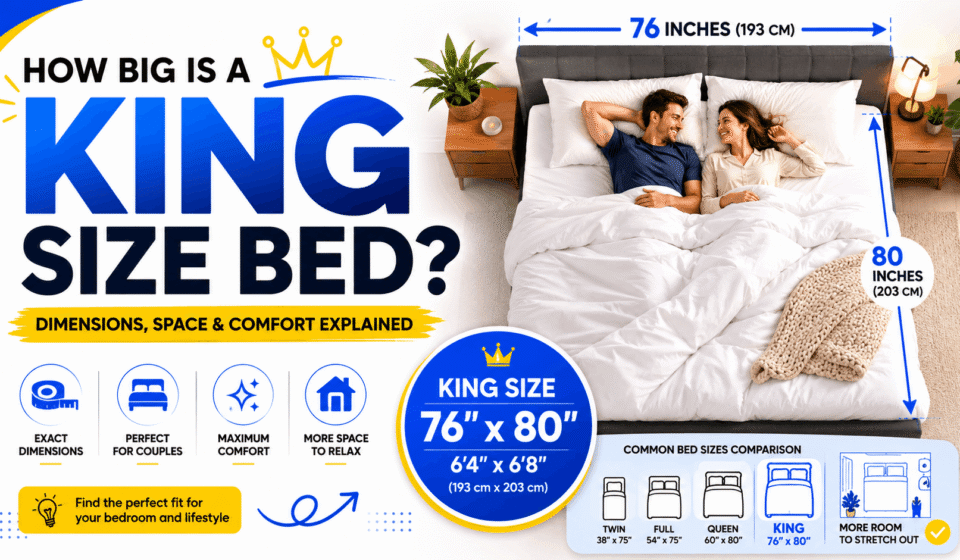

If you’re shopping for a new bed and asking how big a king size bed is before committing to a purchase, you’re asking exactly the right question. Buying a bed that doesn’t fit your room — or doesn’t give you the sleep space you actually need — is an expensive mistake. Let’s get into the real numbers and what they mean in practice.
How Big Is a King Size Bed in Exact Measurements
A standard king size bed measures 76 inches wide by 80 inches long. That converts to roughly 193 cm x 203 cm for anyone working in metric.
To put that width in perspective—it’s essentially two twin XL mattresses placed side by side. A twin XL is 38 inches wide and 80 inches long. Two of them together give you exactly king size dimensions. That’s actually how some couples set up their sleep systems when they want individual mattress control without sacrificing shared bed space.
That 76-inch width gives each person sleeping in the bed about 38 inches of personal space. For reference, a standard single twin mattress is also 38 inches wide. So both partners get their own twin’s worth of room. That’s a meaningful difference from a queen, where the math is tighter.
The 80-inch length handles most adults comfortably. If you’re over 6’4″, you might feel the length constraint—but for the majority of sleepers, 80 inches is more than sufficient.
Standard King vs. California King
This is where people get confused most often. There are actually two “king” options, and they have different shapes.
Standard King: 76″ wide x 80″ long California King: 72″ wide x 84″ long
The California King trades 4 inches of width for 4 inches of length. So it’s narrower but longer. It suits tall sleepers who need that extra foot length. But couples who value width over length are usually better served by the standard king.
The California King also requires different bedding. Sheets, mattress protectors, and bed frames labeled “king” don’t always fit a California king. That’s a detail worth knowing before you buy either the mattress or the accessories.
What Room Size Do You Actually Need
Knowing how big a king size bed is only half the equation. The other half is whether your bedroom can accommodate it without feeling like a furniture maze.
The general recommendation from interior designers is a minimum room size of 12 feet by 12 feet for a king bed. That gives you the bed plus a narrow path around it. But 12×12 is the minimum — not comfortable. A room of 13 feet by 13 feet or larger gives you proper clearance on all sides.
Clearance matters more than people realize. You want at least 24–30 inches on the sides of the bed for walking, getting dressed, and placing nightstands with room to actually use them. At the foot of the bed, 24 inches minimum keeps the room from feeling claustrophobic. If you have a dresser or wardrobe at the foot, factor that furniture depth into the equation too.
The Tape Measure Test
Before buying anything, do this: grab a tape measure and mark out the king bed dimensions on your bedroom floor using painter’s tape. Seriously—76 inches wide, 80 inches long, positioned where the bed would actually sit.
Then walk around it. Open your closet door. Imagine your dresser in its spot. Check that your bedroom door swings freely. This five-minute exercise has saved countless people from realizing — after delivery — that the bed technically fits but makes the room unusable.
I’ve noticed that rooms that feel spacious in everyday life suddenly look very different once you tape out king bed dimensions. What seemed like plenty of floor space sometimes turns out to be surprisingly tight once you account for the full 76 inches of width.
How Big Is a King Size Bed Compared to Other Sizes
Context helps. Here’s how a king stacks up against the other standard mattress sizes.
| Size | Width | Length |
|---|---|---|
| Twin | 38″ | 75″ |
| Twin XL | 38″ | 80″ |
| Full | 54″ | 75″ |
| Queen | 60″ | 80″ |
| King | 76″ | 80″ |
| California King | 72″ | 84″ |
The jump from queen to king is 16 inches of width. That’s significant. If you’ve been sleeping on a queen and feeling cramped, those 16 extra inches genuinely change the experience. Couples who move from queen to king often say they wonder what they were doing before.
The jump from a full to a queen is 6 inches of width. Meaningful but not dramatic. The jump to king is where the real difference lives.
According to the Sleep Foundation’s mattress size guide, a king is the widest standard mattress size available—making it the top choice for couples who are light sleepers, tend to move around, or share the bed with children or pets.
Who Actually Needs a king size Bed
Not everyone does. And buying more beds than you need wastes money and room space. Here’s how to think through whether a king actually fits your life.
Couples with Different Sleep Styles
This is the strongest case for a king. If one partner tosses and turns, runs hot, or gets up frequently at night, that extra width creates a meaningful buffer. The motion transfer between sleep partners decreases as bed width increases—more mattress between you means fewer sleep disruptions.
Couples where one person is a light sleeper and one is a restless sleeper benefit most from the king’s width. Research on sleep quality consistently links sleep disruption from partners to reduced overall sleep quality. More space helps.
Tall Sleepers
If you’re 6’2″ or taller, the 80-inch length of a standard king matters. Most smaller bed sizes cap at 75 inches, which means your feet hang off the end. The king and queen share that 80-inch length, so going king doesn’t specifically help with length. But the California king’s 84 inches does help tall people who also want width.
Families Who Co-Sleep
Kids migrating into the parental bed at night is real life for many families. A king accommodates a parent, another parent, and a small child without anyone falling off the edge. It’s not always the recommended sleep setup, but it’s the reality for a lot of households—and a king handles it far better than a queen.
Solo Sleepers Who Prioritize Space
Some people sleep better with room to spread out. If you’ve always felt slightly cramped on a queen and sleep alone, a king isn’t excessive—it’s just matching the bed to how you actually sleep.
How Big Is a King Size Bed: What You Need to Know
Once you know how big a king size bed is, you need to buy bedding that actually fits it. And king bedding is not the same as California King bedding.
Fitted sheets for a standard king are sized to fit the 76×80 mattress. California King sheets won’t fit—they’re cut for 72×84. Double-check every package before buying.
Flat sheets and duvets are typically sized with extra room, so there’s more flexibility—but “king” and “California king” are still different product labels.
Duvet inserts should be sized at least as large as your mattress, ideally a few inches larger on each side for proper drape. A king duvet for a king mattress usually works well. Some people prefer a king duvet with a California King insert for more generous coverage down the sides.
Budget for quality bedding. A king size fitted sheet requires significantly more fabric than a queen. Cheap king sheets tend to pop off the corners—the extra mattress area creates more tension. Deep-pocket fitted sheets designed for thicker mattresses hold better.
How Big Is a King Size Bed: Frame and Foundation Considerations
The mattress size is just the start. The frame and foundation add dimension to what you need in your bedroom.
A standard king bed frame adds roughly 2–4 inches on each side and 2–4 inches at the head and foot depending on the headboard and footboard design. A bed with a prominent headboard or footboard extends meaningfully beyond the mattress edge.
Platform frames sit lower to the ground. Traditional frames with box springs sit higher. That height affects the visual proportion of the bed in the room and practical things like ease of getting in and out.
King frames typically require a center support leg or beam. A king mattress spanning 76 inches without center support will sag in the middle over time. Most quality king frames include this, but verify before purchasing—especially with platform beds or non-standard frame designs.
The Better Sleep Council recommends replacing both mattress and foundation at the same time for this reason—an old or sagging foundation undermines even a new mattress’s performance.
How Big Is a King Size Bed: The Real Cost of Going King
A king costs more than a queen at every level—mattress, frame, bedding, and sometimes even delivery fees due to size and weight.
Mattress price differences between queen and king typically range from $150 to $500 depending on the brand and materials. Bedding runs 20–30% more for king versus queen sizes. Frames are generally $50–$200 more for the larger size.
Delivery and setup fees can also be higher—king mattresses, especially heavy foam or hybrid models, are cumbersome and sometimes require two-person delivery and setup, which some retailers charge extra for.
That said, if the king size truly fits your needs and your room, it’s worth the premium. A mattress is a purchase you live with for 7–10 years. Getting the size right matters more than saving a couple hundred dollars upfront.
When the room works, the budget allows, and the sleep need is real, a king delivers on every count.
Categories: Bedroom Furniture, Home & Living
Tags: