
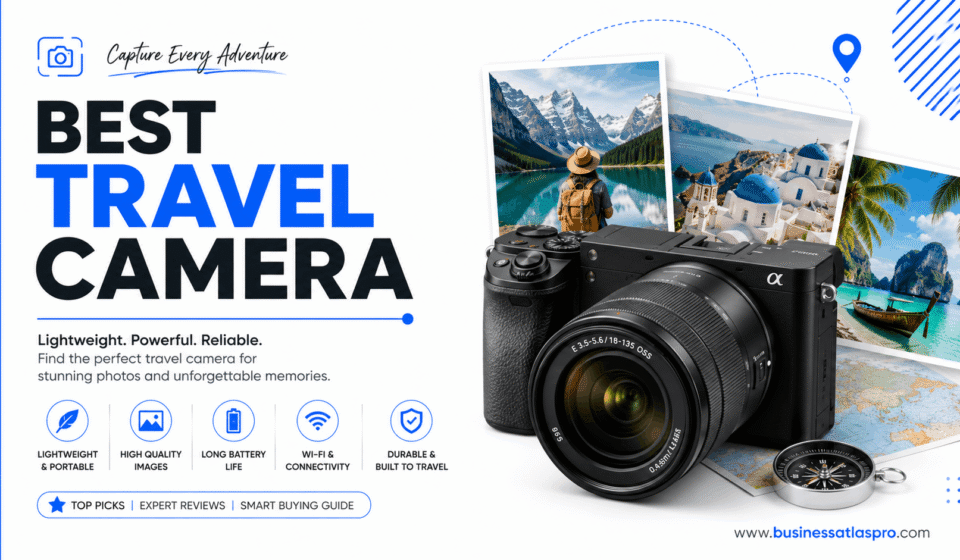

Picking the best travel camera is one of those decisions that sounds simple until you actually start researching. Suddenly you’re buried in specs, sensor sizes, and brand debates. And honestly, most of that noise isn’t what matters most when you’re hauling a bag through an airport at 5am.
Let me break this down the way I wish someone had for me.
What Makes a Camera the Best Travel Camera?
Not every great camera is a great travel camera. That distinction matters. A studio-quality DSLR might take breathtaking portraits. But carrying it through a crowded souk in Marrakech or a rainy hiking trail in Patagonia? That’s a different story.
The best travel camera balances four things: image quality, portability, durability, and ease of use. Miss one of those, and you’ll either leave it in your hotel room or regret bringing it.
Here’s what I mean practically:
- Portability – Will it fit in a daypack without being the heaviest thing in it?
- Image quality – Does it outperform your phone enough to justify the extra weight?
- Durability – Can it handle dust, humidity, and the occasional bump?
- Ease of use – Can you shoot quickly without digging through menus?
That last one is underrated. When a moment happens — a street performer, a sudden sunset, a candid laugh — you need your camera ready in seconds.
The Main Camera Types Worth Considering
Mirrorless Cameras
Mirrorless cameras have taken over as the sweet spot for serious travelers. They’re smaller than DSLRs but deliver comparable image quality. Brands like Sony, Fujifilm, and Canon lead this category.
The Sony ZV-E10 II and Fujifilm X-S20 are solid examples. Both are compact, shoot excellent video, and don’t require a photography degree to operate.
Mirrorless systems also tend to have better autofocus than older DSLRs. That means sharper shots of moving subjects — kids, animals, street scenes — without as much effort.
The downside is battery life. Mirrorless cameras typically drain faster than DSLRs. Carry at least two batteries. It’s just a rule.
Compact Point-and-Shoot Cameras
Don’t dismiss these. A premium compact like the Sony RX100 VII fits in a jeans pocket and shoots video that would embarrass most entry-level DSLRs from five years ago.
For travelers who want one less thing to think about, compacts are genuinely great. There’s no lens swapping. No enormous bag. Just grab it and go.
The trade-off is control. You get less manual flexibility and smaller sensors than mirrorless options. But for travel photography—landscapes, street shots, group photos—a premium compact absolutely holds its own.
Action Cameras
If you’re doing anything adventurous—surfing, skiing, or hiking in rain—an action camera like a GoPro belongs in your kit. They’re waterproof, rugged, and shoot stabilized wide-angle footage that looks great.
But they’re not a standalone travel camera. The fixed wide lens distorts faces. Low-light performance is mediocre. Think of action cameras as a complement, not a replacement.
How to Choose the Best Travel Camera for Your Style
This is where most buying guides go generic. So let me be specific.
If you’re a casual traveler
You want something light, simple, and reliable. A premium compact or an entry-level mirrorless like the Canon EOS M50 Mark II fits perfectly. You don’t need full manual control. You need good auto modes and a lens that covers wide to short telephoto—something in the 24–200mm equivalent range.
Don’t overbuy. A $1,200 mirrorless with three lenses isn’t a travel camera for you—it’s a commitment. Start modest.
If you shoot landscapes or architecture
You’ll want a camera with a wider dynamic range and a good wide-angle lens. A mirrorless camera with a 16–28mm lens equivalent handles cathedrals, mountain ranges, and city skylines really well.
In my experience, the Fujifilm XT series shines here. The film simulation modes give landscape shots a finished look straight out of camera. Less editing time means more exploring.
If you love street photography
Go small and go fast. A camera that makes people nervous isn’t helpful on the street. Something like the Fujifilm X100VI — a fixed-lens compact with a large sensor — is close to ideal. It’s discreet, quick to shoot, and produces images with real character.
DPReview has thorough hands-on comparisons of cameras like these if you want deep technical breakdowns.
Lenses Matter as Much as the Camera Body
This is the thing people overlook. You can have the best travel camera body and completely undercut it with a bad lens choice.
For travel, a versatile zoom beats a collection of primes—unless you’re specifically chasing a style. An 18–135mm or 24–200mm equivalent zoom covers most scenarios. One lens, less to carry, and fewer opportunities to drop something expensive.
If you do go mirrorless, invest in at least one good prime for low-light situations. A 35mm or 50mm equivalent f/1.8 lens is affordable and makes a huge difference indoors or at night markets.
Video: Does It Matter for Travel?
It depends on how you document your trips. If you’re a pure photo person, video specs matter less. But if you want to make even basic trip recap videos, pay attention to a few things:
- 4K at 30fps — minimum for decent quality
- In-body image stabilization (IBIS)—essential if you shoot while walking
- Log profiles — useful if you plan to color grade footage later
Most modern mirrorless cameras handle travel video well. The Sony ZV series is particularly strong here — designed partly with video creators in mind.
And if video is your main goal, consider whether a camera is even the right tool. A recent flagship smartphone shoots excellent 4K video with great stabilization. It won’t replace a dedicated camera for photos. But for video? The gap has closed significantly.
The Sensor Size Question
People get hung up on this. Full-frame vs. APS-C vs. Micro Four Thirds — it sounds complicated, but the practical difference for travel photography is smaller than you’d think.
Full-frame sensors give you better low-light performance and shallower depth of field. But full-frame cameras are heavier and more expensive. Their lenses are bigger too.
APS-C sensors — found in most mid-range mirrorless cameras — hit a great balance. You get strong image quality in a more manageable package. For most travel photographers, APS-C is the sweet spot.
Micro Four Thirds cameras, like those from Olympus (now OM System), are even smaller and lighter. Image quality is excellent, and the lens ecosystem is mature. Worth a serious look if weight is your top concern.
Best Travel Camera: Budget Reality Check
Let’s talk money honestly. The best travel camera isn’t necessarily the most expensive one.
Under $500: You’re looking at entry-level mirrorless or solid compact options. More than capable for most travelers. The Canon EOS M200 or Sony ZV-1 sits here.
$500–$1,000: This is the sweet spot. Mid-range mirrorless cameras with better autofocus, faster shooting speeds, and more customization. Fujifilm X-S10, Sony ZV-E10 II.
$1,000–$2,000: Advanced features, weather sealing, larger sensors. Worth it if photography is a serious hobby.
Above $2,000: Professional territory. Unless you’re shooting commercially, this is probably more camera than your travels require.
I’ve noticed that most travelers who spend over $1,500 on a camera end up regretting the weight more than appreciating the extra image quality. Buy smart, not impressive.
Accessories That Actually Make a Difference For Best Travel Camera
A few things genuinely improve the travel camera experience:
- Extra batteries + charger — Non-negotiable, especially for mirrorless
- A quality camera strap—Peak Design straps are popular for good reason
- A small padded insert—protects your camera inside a regular backpack
- UV filter — Cheap lens protection. Replace the filter, not the lens.
- Memory cards — Carry two. Cards fail. Always at the worst moments.
Skip the massive camera bag. It signals “tourist with expensive gear” and makes you a target. Blend in.
Wrapping Up Your Search for the Best Travel Camera
The best travel camera is the one you’ll actually bring with you. That sounds obvious. But it’s genuinely the deciding factor.
A camera collecting dust at home because it’s too heavy takes zero good photos. A compact you carry everywhere takes thousands. Weight and simplicity win on long trips.
Start with your travel style. Match the camera to that. Don’t buy for the trip you imagine—buy for the trip you actually take.
And if you’re still unsure, rent before you buy. Many camera shops and online services let you try gear for a weekend. That hands-on time tells you more than any spec sheet ever will.
Also Read: IPHUB: What It Is and Why It Matters for IP Detection